Introduction
Hello and welcome. Here are hyperlinks to the recording of my musical work titled Music for Piano Trio, just click on the titles to play:
1 The Dance Of This Dewdrop World 2 Change And Loss 3 Striving Hard
Here you can listen to the trio as a playlist,· Music for Piano Trio
If you would like to send me an email about Music For Piano Trio, or about anything else you’ve read or heard on this website, I would love to hear from you! You can email me at musicforpianotrio@gmail.com
After this Introduction you will come to Music for Piano Trio where you will find dedications, thank-yous, a short history of the work, and a brief description of the forms and musical content. Lastly, if you want to know the story about the inspiration behind this music (which is essentially a truncated personal history), please scroll down to A Brief History, My Story and read on. There you will find a true story about how I came to be a musician after my dad’s suicide when I was 12, and about how that horrible event shaped my adult life. I also talk about some of my time on the Vancouver and Victoria jazz scenes, and about a spiritual journey that changed my life for the better. You will also find hyperlinks in my story of tracks from some of my various recordings as a jazz musician. Just below is a playlist of those same recordings/hyperlinks so you don’t have to read through my story to find the music.
The playlist for A Brief History, My Story: Three Steps Up. A Far Away Place, Dida, House Of Crisis. Life’s Too Short, Twilight Comes (and brings the night), A New Turn,
Also, throughout the website there are additional hyperlinks to the recording of Music for Piano Trio, specifically at the beginning of the both of the main sections (Music for Piano Trio, A Brief History, My Story) and also in the Description of the Forms of the first section (a.k.a. Music for Piano Trio). You can also find the hyperlinks at the end of my brief history and story.
This recording is free. I’m not interested in making any money from this recording (money from music like this?!). Rather, I’m interested in giving back, and so, rather than spend money on this recording – if you can afford it and feel so inclined – all I ask is that you please consider making a donation for music and for life (an amount of your choice) to either the U.B.C. School of Music https://give.ubc.ca/school-of-music OR https://give.ubc.ca/music-scholarship , OR to the Food Bank https://foodbank.bc.ca/donations/donate-now/ , OR please make a donation to a charity of your choice.
The primary purpose of this website is to showcase the music and recording of Music for Piano Trio. Music for Piano Trio is my musical tribute to music itself, and to my mother Ellen Nielsen and her sister Inger Karlsen. All three of them saved me from a potentially very hard life after my dad’s suicide when I was very young. Music for Piano Trio is also a tribute to Zen Buddhism; this is my way to give thanks for how Zen helped me grow and more fully appreciate my life.
The secondary purpose here is to tell the true story about how I came to be a musician, and about the healing and redemptive powers of love and music (with some added good luck thrown in for good measure). I normally wouldn’t tell a story about myself. I’ve argued with myself extensively about whether or not to actually tell this story. In the end, I decided to share my history, I somehow felt compelled to speak my truth and lay it on the line.
This recording is not for an album, it is strictly a vanity recording; it’s probably my last kick at the can for making a musical offering. Multiple Sclerosis has taken away cognitive and physical abilities, making noodling on the keyboard and writing music really hard if not impossible.
My life history and Zen are both a big part of the inspiration behind this music, although one wouldn’t necessarily get that from just listening to it. Does one need to read my story in order to appreciate this music? No! But you might gain some extra insight if you do, especially if you knew me back in the mid 80’s.
So, I’m saying goodbye to my lifelong active participation in music with this recording (albeit a bit after the fact). It’s a tribute to music itself, and to my mom and aunt. It’s hard to say goodbye but it feels right, and I think it’s a fitting conclusion to that chapter of my life.
Thanks for your time, and I hope you enjoy Music for Piano Trio and my story.
If you would like to send me an email about Music For Piano Trio, or about anything else you’ve read or heard on this website, I would love to hear from you! You can email me at musicforpianotrio@gmail.com
• • • • • • • • • • • • • • • • • • • • • • • • • • • • • • • • • • • •
Music for Piano Trio
1 The Dance Of This Dewdrop World 2 Change And Loss 3 Striving Hard
Dedications and Thank-yous
Music for Piano Trio is dedicated to:
- The loving memory of my mother, Ellen Nielsen, and Ellen’s sister, Inger Karlsen. Ellen loved me as only a mother could, and they both gave me so very much – including my life.
- Zen teachers Chozen Bays Roshi and Hogen Bays Roshi, co-abbots of Great Vow Zen Monastery, and to all the residents that have lived there in the past, presently, and in the future.
- All the musicians I’ve ever played with on the bandstand, in the studio, and in the living room; and to all the musicians who knowingly or unknowingly helped teach me the hard but necessary life lessons. Namaste.
- As always, I must acknowledge the indispensable force of my dear wife Jacqui Brinkman, without whom nothing would happen.
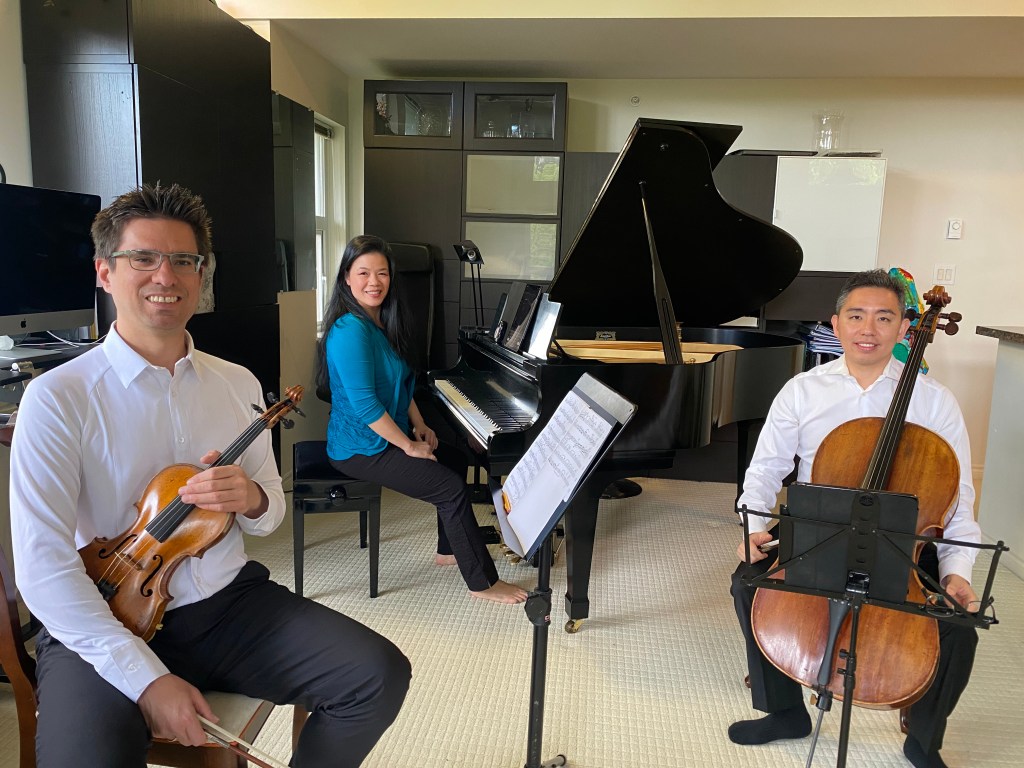
This recording features Domagoj Ivanovic (violin), Sungyong Lim (cello), and Karen Lee-Morlang (piano). A big thank-you and immense gratitude goes to Domagoj, Sungyong, and Karen. Their courage to try something new musically, their great musicianship and absolute professionalism have been very inspiring. It’s been thrilling and amazing to watch and listen to these very fine musicians rehearse and record my music.
This recording would never have happened without Karen (whom I first met at the U.B.C. School of Music about 30 years ago). Karen sincerely wanted to do this music, so I let her pick the members of the trio and she organized all the rehearsals (they rehearsed at her condo). This group was great to work with, and their performance is outstanding. I think they have made a beautiful recording. I hope you enjoy the music and the recording.
Also, thanks to Stephen Miahky, Alex Cheung, and Rachel Kiyo Iwaassa for the original workshopping of this music, and to Pro Musica/Sonic Boom for presenting the workshop concerts all those years ago. Upon revisiting this music years later (starting the process of revising the score), I have had to make and eat a lot of humble pie. I had to revise much of the original drafts – there were many things that could have (and should have) been notated better. Stephen, Alex, and Rachel, did an amazing job for those first workshop performances, certainly given the naïve efforts of my original score.
Last but not least, a huge thank you to Paul Silveira and Armoury Studios for stepping in at the last minute when the studio we were originally scheduled to record at cancelled due to a sudden illness. Paul (manager and chief engineer), Ricardo Germain (assistant engineer) and Jessica Schmidt (runner) were great to work with, and Paul got us a fabulous sound. They even came in on Canada Day long weekend to record us!
About the Music
I started writing the trio around the beginning of the 2000s and had the last of the workshop performances in 2004, within months of quitting playing the drums professionally after 20 years. I eventually shelved it around 2010 as teaching and other interests were vying for my time. I retired from teaching in 2018. In late 2019, after M.S. took away my ability to go into the backcountry (amongst other things), I started looking for something worthwhile to occupy my time with, and so, I revisited the trio.
Music for Piano Trio was my first and probably only attempt at writing music with the focus on bringing the groove and dance of Afro-Cuban music and jazz into the realm of classical chamber music. It is the result of my own musical predilections at the time, as well as several conversations I had had with a dear friend and composer, Paul Nicholls (a.k.a. Paul Alexander). We talked at length about many things to do with contemporary chamber and orchestral music; in particular, how we would love to hear this music really groove to a sophisticated, contemporary sound.
I wanted to write piano trio music that pays homage to that great tradition of music composition, and take it to a more contemporary place that’s not so much about avant-guard music but rather more about jazz and Afro-Cuban music. Having said that, this is NOT jazz. In fact, it’s not any one particular music genre – I’ll leave it to the listener to pick things out. There is no improvisation in this music (arguably, that would make it jazz music, which was not the intended focus when I first wrote the drafts). However, there are some jazz lines in the 1st movement, as well as jazz harmonies in the 1st and 3rd movements.
Apart from mixing genres together, this music is rather old-school and non-avant-guard. There’s nothing new here in terms of style, melody, harmony, rhythm or tonality. If there’s anything inventive about this music, perhaps it’s in the way it mixes the old with the new: old and familiar classical forms and styles mixed with jazz harmonies and lines, and a smattering of Latino and Afro-Cuban music. I sometimes think of this music as a musical depiction of a composer from the mid-1800s being transported in time to the 1960s. This composer is then exposed to jazz and Afro-Cuban music, and then she/he composes a musical response.
A Description of the Forms
The music is in three movements, using the old baroque/classical music format of the 1st movement being fast, the second movement slow, and the third returning to fast again. Each movement is titled with a name that references an aspect of the study and practice of Zen Buddhism.
The 1st movement is called “The Dance of This Dewdrop World.”(1 The Dance Of This Dewdrop World) This is in reference to the haiku written by Zen poet Issa (1763–1828) which reads: “This dewdrop world is but a dewdrop world, and yet…” translated by Gary Snyder. Gary comments further, “That ‘and yet’ is our perennial practice. And maybe the root of the Dharma.” The dance is a loose ABA form that goes through a rather circuitous tonal journey where the home key of A Dorian isn’t returned to until near the end of the recap. The piece begins with an Afro-Cuban/jazz influence (perhaps inspired by the piano stylings of Keith Jarret). The B section begins with pizzicato cello and a violin solo, which then continues with a cello and violin pizzicato section. The B section concludes with some jazz lines on the piano, and then pedal tone sections just before the recap (first on C# then on C#7). I often think of this dance as a bastardized version of a sonata allegro form; however, in reality it is different. The dance attempts to reflect the busy nature of the world, which in the grand scheme of things is neither happy or sad, surprising yet consequential, and somehow logical.
The 2nd movement is titled “Change and Loss,” (2 Change And Loss) and is a through-composed piece with some of the motifs restated in various ways. It’s inspired by the music of the late romantic period, with no real use of the aforementioned influences. Change and loss are important topics in the Zen canon. Zen can be viewed as a study of life and death, and as such, change and loss are paramount in Zen teachings. Change and loss are some of the most challenging aspects of just being alive, and so the mood of “Change and Loss” attempts to reflect the bitter/sweet emotions that often accompany the experience of change and loss.
The 3rd movement is a rondo titled “Striving Hard.” (3 Striving Hard) This movement probably best accomplishes what I had initially set out to write (an attempt at fusing together Western traditional classical music with the contemporary sounds of jazz and Afro-Cuban music). The rondo form is one of the most widely used forms in the classical music tradition, used by such composers as Hayden and Mozart and countless others. The rondo’s characteristic repetition of sections was (for the purpose of writing this piece) an effective way to bring together the music genres concerned here. The movement’s title, “Striving Hard,” is in reference to a widely-held notion in Zen practice, which states that “the great way is not difficult, strive hard!” (quoted by many, original quote is unknown to me). From my own experience, striving hard is about humility and compassion; striving hard to not think while meditating, but also practicing with the creative and non-linear process of acknowledgement, acceptance, and transformation. Striving hard is a fact of life. Striving hard can be joyous and/or difficult, and it is something we all must do – strive hard!
If you would like to send me an email about Music For Piano Trio, or about anything else you’ve read or heard on this website, I would love to hear from you! You can email me at musicforpianotrio@gmail.com
• • •. •. •. • • •. • • • •. • •. •. • •. •. •. •. •. •. •. • • • • • • •. •. •. •. • • • • • •
A Brief History, My Story
1 The Dance Of This Dewdrop World 2 Change And Loss 3 Striving Hard
Before I tell my story, I just want to say that my story (while perhaps being a bit unique), is not a story of hard times. There are people who have truly suffered in this world – I’m NOT one of them. I offer this story as a source of inspiration, and as a chance to speak my truth. If nothing else, this story tells a bit about The Classical Joint, the Cambie Street warehouse (both in Vancouver), and the life of a modestly successful jazz drummer in Vancouver and Victoria during the mid 80s, 90s and early 2000s. There are many people who are important to me who are not mentioned here, and I’ve also omitted many details. My memory is failing (probably because of all the drugs I did as a youth, and because of M.S.) and I didn’t want to write a book…
I love music, I always have. My earliest memories (perhaps at age 3) include my mother, Ellen, and how she sang to me, and later she sang with me. At age 6, I started playing the accordion, it was a very Danish thing to do (my parents immigrated from Denmark in 1951). I would listen with Dad to many of his records (from James Last to Earl Grant to Johann Strauss) or with my brother Paul, listening to The Beach Boys or Live at Woodstock. At age 10, I rebelled and took up percussion in the school band, eventually convincing my parents to rent me a drum set.
At age 12 my dad took his life – I was the one who found his body. Luckily, I was not alone when I found him. I was just home from a sleep over at a friend’s house, and my friend and his mother were with me when I found my dad. This tragic and catastrophic event essentially ruined my adolescence and early adulthood, but it also eventually set me on a path of self-healing and growth. I had no idea of just how effected I would be by this terrible happening, and I’m still learning about it even today – as I write this, I’m 59.
From age 13 to 16 I walked a tightrope, that, had I fallen off, I would have plunged into an abys of self-destruction. There’s a good chance I would have been in juvenile detention had the police ever caught me, and who knows where that would have led. I was a teenager full of anger, dealing with guilt and a lack of self-confidence, suffering from self-numbing which led to addictions (more than one), and having an attitude of uncaring and searching for an easy way through life; this was all strangely combined with the perfectionism I had learned when I was younger.
As therapy, I would play – sometimes bash – the drums; I did this for hours most days throughout my entire adolescence. Through music, and with the undying and unflinching tough love of my mom, around age 16, I slowly began to extricate myself from the nasty group of punks that I was hanging with. This was an incredibly important move for me to make. I started hanging out with my older cousin who played electric bass. We had a jam band (a guitar trio) which was probably not a bad little jam band. My cousin Dave and his friend Konrad had some chops. We jammed on Jeff Beck and Rush tunes, and other bands as well. We even sat in at a couple biker parties in Richmond, where I grew up.
A crucial reason for this change was my mom, who pleaded with me, or scolded me when I came home stoned or drunk; she was always searching for a way to turn me around and get me away from a bad scene (my mom never gave up on me, even though I gave her many reasons to do so). While it didn’t stop me from smoking a lot of pot and drinking a fair bit, hanging with Dave, Konrad, and a group of older young adults (some of whom played musical instruments) did get me out of an unhealthy social scene and away from doing petty crime.
Fast-forward a few years, whereupon I argued with Mom that I should play the drums for a living. She successfully argued that if I was to play music for a living, I should then attend music school. So, I enrolled at V.C.C. Music and attended classes there for almost 2 years before dropping out, joining a rock band, and going on the road for about 2 more years. That was an amazing experience; I saw a good chunk of Canada, met all kinds of people and learned a lot about life in different parts of the country. Mom, on the other hand, worried for my safety and my future. We were a B circuit bar band that played all over western Canada (anywhere between Flin Flon Manitoba and Vancouver Island).
I should mention that while attending V.C.C. I had the very good fortune to take a jazz history class with Alan Matheson – more about that later.
After quitting the rock band, I moved to Mom’s sister’s place in West Vancouver. My intention was to stay there for a month or two and figure out what I was going to do next. You have to understand that even though I’d survived adolescence and was now a young adult, I was still dealing with all the detritus of Dad’s suicide – anger, guilt, no self-confidence, addictions, emotional detachment and perfectionism. What was supposed to be a couple of months turned into 9 years.
My aunt Inger was a very important and special person to me. She owned a beauty salon that was on the main floor of her house on Robson Street in downtown Vancouver. When she sold her 2 houses and eventually her business on Robson, she moved to West Vancouver. She lived in a beautiful house right on the beach near 15th and Argyle in West Van. Apart from that, she also bought another rental property in West Van, property in Whistler, and a small modest cabin cruiser boat.
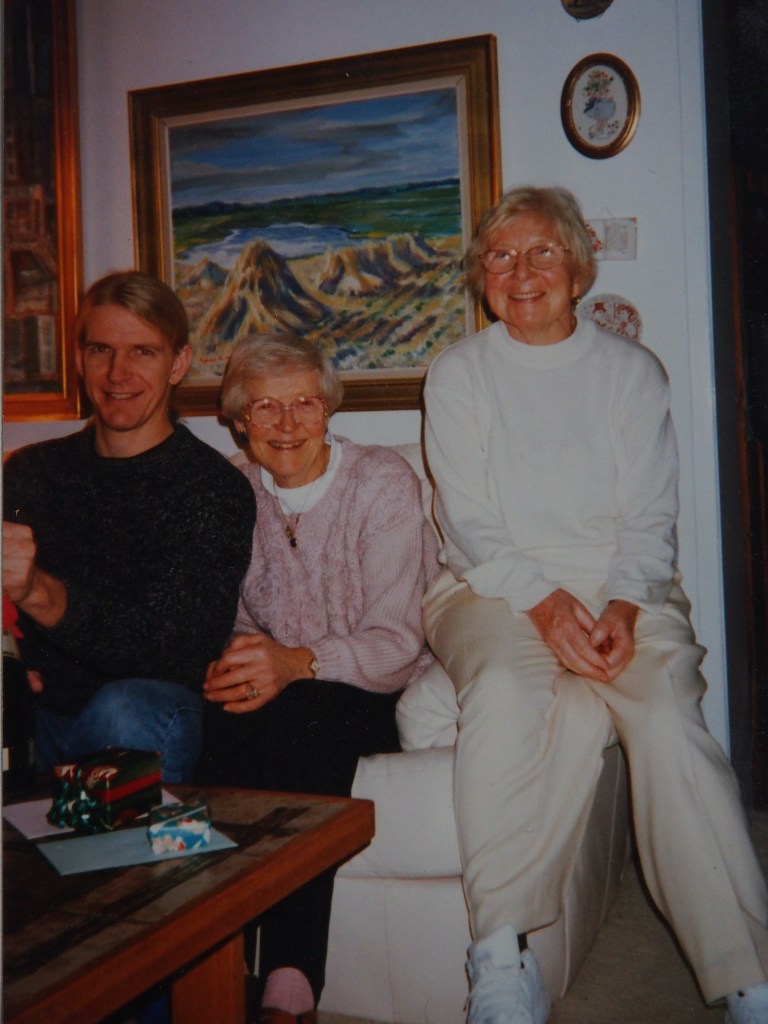
While staying at Inger’s in West Van, I got a job for a time trying to sell musical equipment, which I failed at miserably, but the job did give me a place to practice after work. I started hanging out at the Classical Joint down in Gastown and started regularly attending the Tuesday Night Jam Sessions there. The first time I sat in at “The Joint” (trying to swing), I was sitting in with Mike Lent on bass and Ted Quinlan on guitar, and I was playing on drums belonging to Jim Chivers, who became a good friend and a mentor to me (35 plus years later we’re still good friends).
As a young guy trying to play jazz drums, The Classical Joint was THE PLACE to hang out and listen to some of the best jazz that Vancouver had to offer. I learned how to play jazz there by watching, listening, and sitting in. I met many players at The Joint, and befriended a number of them.
During my years of hanging out, sitting in, and doing gigs at The Joint and around town, I had the extremely good fortune of sharing a rehearsal space with none other than Hugh Fraser, Phil Dwyer, and Chris Nelson – holy shit! They needed a fourth person to contribute to the rehearsal space rental, and I was the lucky one to get the opportunity. Imagine, a kid in his mid 20s, who was trying to learn how to play jazz drums (but really didn’t know much about it), was actually hanging with 3 of the young lions of the Vancouver and Canadian jazz scenes, this back in the mid 80s; they were amazing, world class jazz musicians (Phil still is).
As an aside, and just in case you didn’t know: Hugh Fraser has won 2 Juno Awards: for Best Jazz Album in 1989, and Best Mainstream Jazz Album in 1998. Phil Dwyer has also won 2 Juno Awards: for Best Mainstream Jazz Album with Dave Young in 1994, and Best Contemporary Jazz Album of the Year in 2012. Phil has also appeared on several other Juno Award winning jazz albums as a side man, and he was awarded The Order of Canada in 2013 for being the incredible talent that he is, and for his many contributions and achievements. Both Chris and Phil played in Hugh’s quintet and in Hugh’s big band, VEJI (Vancouver Ensemble of Jazz Improvisation). Sadly, in 2004 Chris died, and then Hugh died in 2020, but thankfully their memories and legacies live on. Rest In Peace, Chris and Hugh, I think of you both – often.
The rehearsal space that I shared with Hugh, Chris, and Phil, was downtown in an old warehouse located on Cambie Street just north of Dunsmuir, not far from The Joint. It was actually an artists’ colony with a storefront selling masks and other art decor on the main floor, the second floor was all artists (painters, sculptors and potters), and the third floor was all jazz musicians – Ron Samworth, Scott White, and Dennis Esson, just to name a few.
During that time in the mid 80s, I reconnected with Alan Matheson, whose parents lived in West Van near to where I was living with Inger. Alan was keeping his record collection at his folks’ place. Alan’s collection was/is enormous, he probably has about four thousand jazz LPs and 45s, and likely other stuff as well. I had some charts of Thelonious Monk’s tunes; Alan asked if I had ever heard them played by the man himself. When I said no, he generously offered to record some tracks for me if I would give him a blank cassette tape. One thing led to another and before long, I was meeting Alan at his parent’s house, I supplied the blank cassettes, pizza (and I think beer), he supplied the recordings. He talked, I listened. I learned a lot from Alan, both from his jazz history classes and from hanging at his folks’ place. I will always remember and treasure those sessions. I still have the first tape that Alan put together for me – the Monk tape (carefully annotated with who soloed on which tune), it’s a real treasure.
At this time in my life, I was clearly moving forward, practicing a lot, making some important connections, and learning a lot about jazz. But at a deeper level I was very unhappy. In general, I found people to be a real mystery and I didn’t understand human nature very well. I also didn’t understand why I was so unhappy. However, I did realize that I was angry and bitter about Dad’s suicide, and I missed the benefit and influence of having him around.
Fast forward again. I had some great opportunities presented to me, one of which was attending the Banff Centre. Over the course of about 5 years I attended 3 jazz workshops there. As well, I was taking lessons and hanging out with the great jazz drummer and composer Claude Ranger, and the equally amazing post-bop drummer Rocky Weems. I also received a Canada Council grant to travel to New York and take lessons with Terry Clarke and Victor Lewis.
But, the most important turn of events was that I put a band together with Ross Taggart on piano, Bill Runge on saxes, and Ken Lister on bass. I worked with Rick Kilburn to get a F.A.C.T.O.R. grant for recording a CD, which he produced. Here’s are a couple tracks from that CD, called Between The Lines. Three Steps Up. is a blues and A Far Away Place is kind of a ballad/epic straight eighths tune. I wrote both of these tunes.
I have to mention this: The CD cover for the Between The Lines CD is garish, very tacky, and it tells very little about the music – there’s not even a photo of the band. This album cover is very indicative of my mind set at the time. I had little understanding of human nature or how the music business actually worked, and I didn’t fully understand the skill of the musicians I was playing with – and they were all such great players. This CD cover is an indication of just how messed up I actually was. Too bad, the band really played great, and Rick got us a fabulous sound. In hindsight, I should have waited a few years before making this CD, I needed to mature more as person and as a player.
After making this CD, I then scored us a Canada Council touring grant and we toured the country. During that time, I hung out quite a bit with Ross, he was not only a great young player (probably in his early 20s at the time), he was also a very funny man. Unfortunately, Ross died in 2013. Rest In Peace, Ross. Like Chris and Hugh, I think of you often.
During those years, even though I was starting to have some success, I was still plagued by my past. All those aforementioned problems were still there – all of them. At times, I would be very unhappy (I don’t think anyone else knew this); outwardly, I seemed to be going forward, but inside, these issues left a burning pit in my heart.
After a few years of nagging me, my mother and then girlfriend Lindsay (who is a very fine keyboardist and comes from an educated family), convinced me to go to university and study music. Lindsay suggested, and I agreed, that an undergrad in music composition was a better option than performance. As I was fairly well studied as a jazz drummer, studying composition would be some new musical territory. I started classes at the U.B.C. School of Music in 1993.
I got a place, sharing the top 2 floors of a house with the great jazz pianist and composer, George McFetridge – wow, another stroke of good luck! Living with George (and his daughter Shaunie part-time) was a real eye-opener. I probably learned as much about music from George as I did from U.B.C. Music. Like the days at The Joint and the Cambie Street warehouse, this was a very happy time for me.
After completing my undergrad at U.B.C. Music, I went back to doing gigs, this time moving to my Mom’s place in Deep Cove on Vancouver Island (near Victoria). Part of the arrangement was that I would look after her place in the wintertime while she spent time at her winter place in Arizona.
Through Hugh Fraser and Ross Taggert (who both grew up in Victoria) I made friends with three stalwarts of the Victoria jazz scene, trumpeters Bruce Hurn and Mike Herriott (Mike is also a great bassist) and veteran saxophonist Ed Philp.
As well as playing gigs, I would often find myself hanging out with Ed, Bruce, and Mike, either at Ed’s house or at Hermann’s Jazz Club (a focal point of the Victoria jazz scene). We would often show up and play at the jam sessions there, ran by pianist Tom Vickery (another Victoria stalwart). Often, Mike was playing bass with Tom for the jam sessions.
I was –and still am – very grateful for their friendship, and for having the privilege and pleasure of sharing the bandstand with these great players. For many years (long after I moved back to Vancouver), I would reconnect with Bruce and Ed whenever I was visiting Mom, and we’d go downtown to Hermann’s to see, hear, and sit in with Mike on bass playing with Tom.
My time on the Victoria jazz scene was short (maybe a couple of years), but I have many fond memories of Victoria and the people, especially hanging out and playing with Ed (Rest In Peace), Bruce, and Mike.

I was wanting to get back to Vancouver, primarily because I was accepted to the U.B.C. Faculty of Education to complete a Professional Development Program that would give me the qualifications to become a school teacher.
After getting back to Vancouver, I reconnected with the jazz scene and soon started thinking about putting another band together. My second band was phenomenal, with George McFetridge on piano, Mike Allen on saxes, and Steve Holy on bass. We made a CD which was originally recorded as a C.B.C. Jazzbeat show, this was combined with some tracks from other recordings. Here is a track from that CD called Up For The Count; this track is called Dida. Also featured, another track of the same band but from a different CD that Cory Weeds put out called Live At The Cellar, this track is called House Of Crisis. Again, these are tunes I wrote.
We toured Canada, once again I received a touring grant from the Canada Council. George was replaced by Tilden Webb for the tour; it was a very hard decision for me to make, but personalities and attitudes about music between me and George had drifted apart (as often happens in bands). I owe George a huge debt of gratitude for what he taught me about music and jazz, and I’m very sorry things didn’t work out.
Having Tilden in the band took us to another level. We never made a CD, but we did make a C.B.C. Jazzbeat recording while we were in Montreal on our tour. I had bought the master with the intention of making a CD using these tracks but I quit the scene before that happened. Here’s 3 more tracks from the CD that never was. The 3 tunes included here I also wrote: Life’s Too Short, Twilight Comes (and brings the night), and A New Turn.
After completing the P.D.P. Program at the U.B.C. Faculty of Education, I became a music and band teacher. I started teaching music and band at Emily Carr Elementary in Vancouver, and wound up teaching there for 18 years. I started there as a part-time teacher. I took my first class on September 9, 1999 at 9:00AM (the ninth hour, of the ninth day, of the ninth month, in the ninth year of the ninth decade of the 1900s!). My mother was ecstatic and very relieved that I finally had a real job.
Not long before I quit playing, Steve (my best friend), quit playing the bass, and he was briefly replaced by Adam Thomas – another great player. Steve later got back into playing after his daughter, Talia, had grown up. But by the time Steve returned to playing, I had quit the stage and was learning about what it meant to teach music to kids.
It was the summer of 2004 and it was my quartet playing outdoors at Gassy Jack Square as part of the Vancouver International Jazz Festival. It was the last gig I ever did as a band leader. I remember looking out on the audience as we played, and seeing a table of many of my colleagues, enjoying a beer and checking out the band. I was instantly hit with the thought that they were probably thinking that the band sounds pretty good, except it would be better if Bruce was a better drummer. I was deeply unhappy being a jazz drummer, even though I was playing with a kick-ass band. Perfectionism, and my lack of self-confidence had ruined being a jazz musician for me. Apart from a gig I did for Cameron Chu, a good friend up in Whistler, I never played again. The dwindling live jazz scene in Vancouver, combined with the fact that I still suffered from all the maladies that I had learned as a result of my dad’s suicide, made quitting the scene attractive. I was offered a near full time position at the school I taught music and band at, so, I took the gig and left the stage.
Not long after I had quit the drums, Steve introduced me to Zen Buddhism and meditation. I was searching for an end to all the mental anguish and suffering. Zen made sense to me, and the meditation – though hard at first – really showed me the value of learning about myself through meditation (paying close attention to the breath, sensations, or to sounds). Zen also taught me valuable lessons about impermanence – actually a very profound truth – and Zen Buddhist ethics (the 10 grave precepts and the 3 pure precepts).
After quitting the stage and becoming a school music/band teacher, I had summers completely free. This gave me the chance to go into the backcountry again, which is something I’d always had a deep connection to. Ever since the age of 4, my mother would take me skiing. All through my childhood and teenage years, I loved skiing. By the time I was 15, I was an expert skier, able to ski even the double diamond runs (which are the most technically challenging). My connection to skiing gave me a love of the alpine, which led me to becoming a hiker and a backpacker – eventually a solo backpacker, able to negotiate difficult terrain and be at home in the backcountry by myself.
I learned A LOT going solo backpacking; mostly about living with the knowledge that if I wasn’t careful and skillful, I could get into serious trouble being out there alone (or even die). I also learned about how nature works, how life is all around you (even in the dirt you’re walking on), and about what’s truly important in life. Solo backpacking and Zen go hand in hand in many ways; they both teach you about life and death, the laws of nature, and about life beyond the human realm.
Zen and being a music/band teacher eventually started to open up my heart. I attended many week-long silent meditation retreats (called sesshin) at Great Vow Zen Monastery down near Clatskinie, Oregon. From 2005 to 2018, I attended well over 20 sesshin there. I learned a lot about my afflictions and did a lot of healing. I also learned a lot about life and death, and how to be a better person.
Zen Buddhist precepts are structured differently from the Christian 10 Commandments. The Zen precepts have 2 sides to them: the goal, and what not to do in order to get there (such as precept #4, which reads, “Manifest truth, do not lie.”). Zen precepts point to right living and teach how to do that. However, even after practicing Zen for over 15 years, from time to time I still fail. I catch myself breaking a precept – usually the one about not getting angry – but when that happens, I just get back on the horse. Steve once told me, “there’s only one way to practice with the precepts… try.” I took my vows on March 25th of 2012 (a year after I was diagnosed with Multiple Sclerosis), and I practice with the precepts to this day.
Zen Buddhism has improved my life immeasurably. Without Zen, I would have never been able to marry my lovely, amazing wife, Jacqui. Before Zen I suffered from all the previously mentioned afflictions, and who would marry a guy like that? Had I learned earlier in my life the important lessons Zen has taught me, I probably would have been a better player too.
So, it was music and the great love of my mother and my aunt that saved me, and Zen helped me to become a more mature and happy person.
Upon Further Reflection
I consider myself very fortunate to have chosen music as my path through life – or is it that music chose me? I’m very thankful for all the amazing musical experiences and opportunities, and for being befriended by so many truly inspiring people. Luckily, I had enough ability to have some modest success as a jazz drummer.
Ironically, in hindsight, the one thing that I truly lacked in was listening and as a musician I find it hard to admit to this. Although I was very good at listening to music, I was rather deficient when it came to listening to the most important thing – me. Or, perhaps more accurately stated, I was not very good at listening to what my own intentions and emotions were telling me.
Having made that observation, I have to remember to cut myself some slack about it. When I was a teenager and later as an adult, my life was filled with darkness and my outlook on life was less than optimistic. I didn’t understand anything about intentions or emotions, much less care. And, it took a long time for me to figure out how to be a kinder, gentler, better person in the world (actually, it took decades). Not having a normal adolescence didn’t help the situation. Furthermore, like everyone else I had to learn as I went along, making mistakes along the way – there’s no manual for getting through life.
If I had been able to listen to myself more closely, I might have understood more about grace and humility too. It’s hard to live with grace when you’re angry. Likewise, it’s equally difficult to understand humility when you’re only concerned with attaining expertise and furthering your career. Years later, I had to quit playing the drums professionally, take up Zen, and start teaching music and band to kids in order to realize this. Like music, grace and humility are unfathomable, you never learn all there is to know about them – there’s always more to know.
Decades earlier in Manhattan, I had had a lesson with Victor Lewis, the great jazz drummer. Near the end of my lesson with him, he said, “Humility covers both strength and weakness.” I don’t remember what prompted Victor to say that, but I’m very glad he did. At the time, I wrote down what he had said, and I pondered it for a long time. Years later, I found the paper with the note on it, and I came to understand more about the gravity of what he had said. In my own words: When you don’t know how to do something (a weakness) and you want to learn, your mind is wide open; your mind has the much-needed humility to stay open and flexible, and so you learn. In Zen, this is called Beginner’s Mind. On the other hand, when you know something like an expert (a strength), you still have to have the same humility to stay open and see all the possibilities – to have a flexible mind and not believe that you necessarily know the answer or what to do next. I’ve come to the realization that a lack of humility can lead to close-minded arrogance. And so, in light of all this I go forward from here, continuing to learn about strength, weakness, grace, humility, and of course, always, impermanence.
I’ve also had to learn to forgive my dad for what he did; no doubt he suffered a lot before he took his own life, and no doubt his suffering and torment clouded his view. I know my dad loved me and that he wanted the best for me. Like grace and humility, forgiveness is so important for me to have, and for me to heal.
Going forward: Living with M.S. is a much subtler game of life than it was before M.S. took hold. Since I can’t do music or go into the back country anymore (like I used to), plans have changed. Now, I’m learning more about being satisfied with less and eating less, having a gentler approach to living, letting go of my perfectionism (it’s the enemy of the good), and letting go of my lack of confidence – all those small unimportant concerns. This is what’s most important for me now – so is being a loving husband and learning to have fun again. It’s all about how I am – right now – and how I meet life – right now. For me, these are what matter the most.
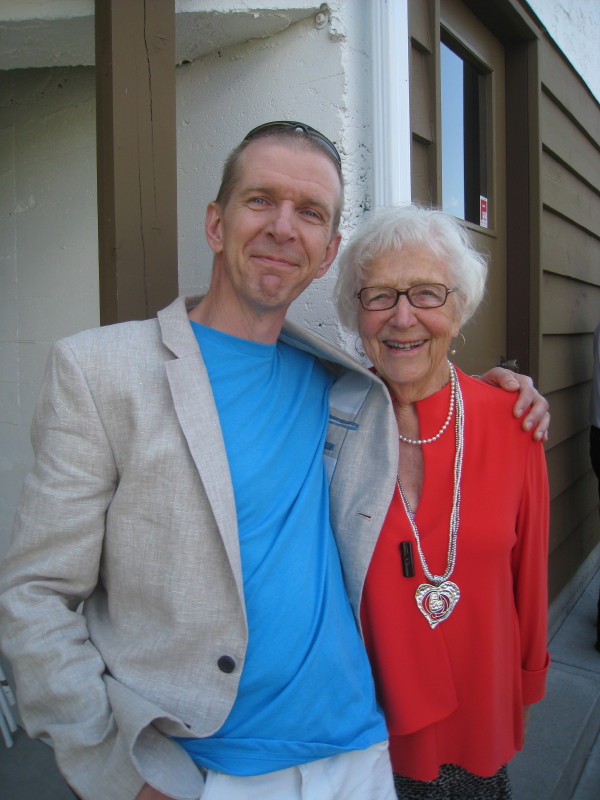
As a tribute to Mom, Inger, Zen, and to music itself, I offer Music for Piano Trio: below are the hyperlinks once again… I will end by saying that I never truly thought this recording would ever happen, nor did I ever expect that serious players would ever want to tackle this music. Again, my deepest gratitude goes to Karen, Domagoj, and Sungyong, their skill and courage are humbling and inspiring. Thank you for listening to Music for Piano Trio, and for reading my story. I humbly offer this music – with all it’s perfect imperfections. With palms together, I deeply bow.
The playlist of everything available on this site: 1 The Dance Of This Dewdrop World 2 Change And Loss 3 Striving Hard also Three Steps Up. A Far Away Place, Dida, House Of Crisis. Life’s Too Short, Twilight Comes (and brings the night), A New Turn,
If you would like to send me an email about Music For Piano Trio, or about anything else you’ve read or heard on this website, I would love to hear from you! You can email me at musicforpianotrio@gmail.com
 Music for Piano Trio